
Specify the loads. Let the optimizer grow the part.
Most design starts with a shape and checks if it's strong enough. Topology optimization inverts that: you give it the loads, the supports, and a material budget, and it decides where every gram of material should go to make the structure as stiff as possible. The answer is the organic, bone-like, trussed forms that are the signature of generative design — and they're not drawn, they're discovered, by finite-element analysis in an optimization loop. It's the hottest idea in modern CAD, built here from scratch.
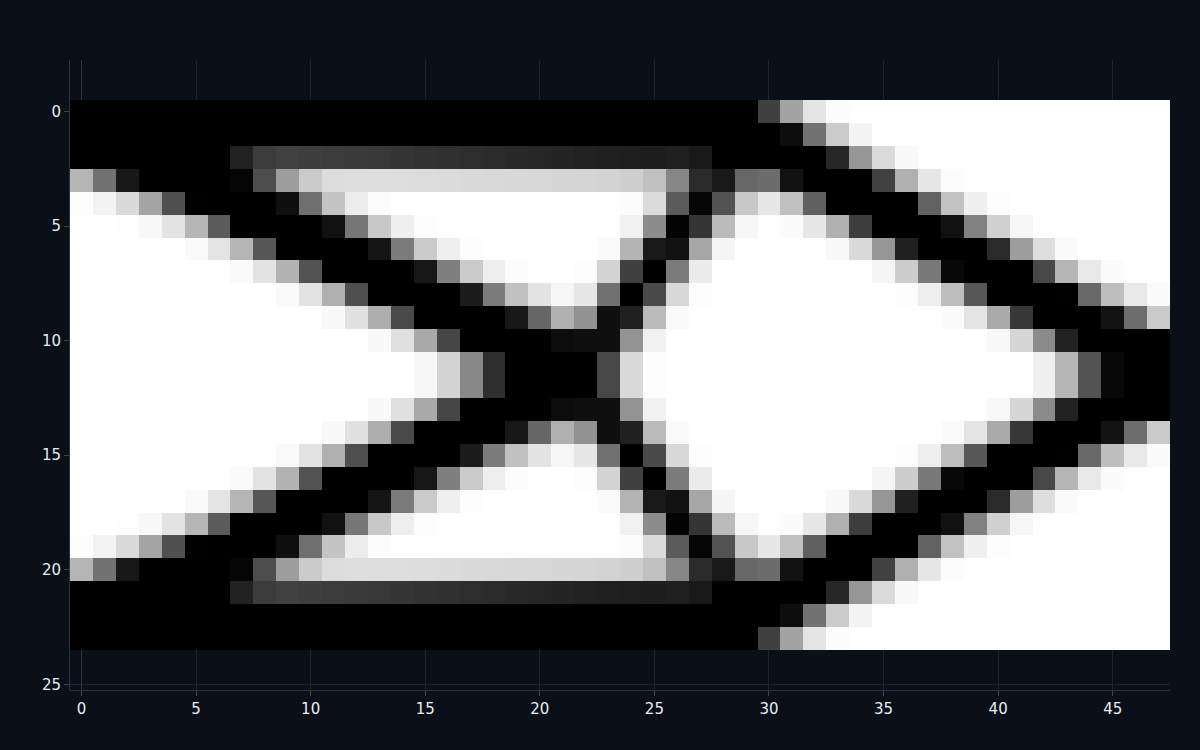
Make every element choose: material, or void.
The optimizer works on a grid where each element has a density between 0 (void) and 1 (solid). The catch is that a half-dense element is uselessly weak for the material it spends — so the SIMP scheme penalizes intermediate densities, raising stiffness as density-cubed. That penalty forces the design to commit: each element goes black or white, solid or empty, and what's left is a real, manufacturable structure rather than a gray smear.
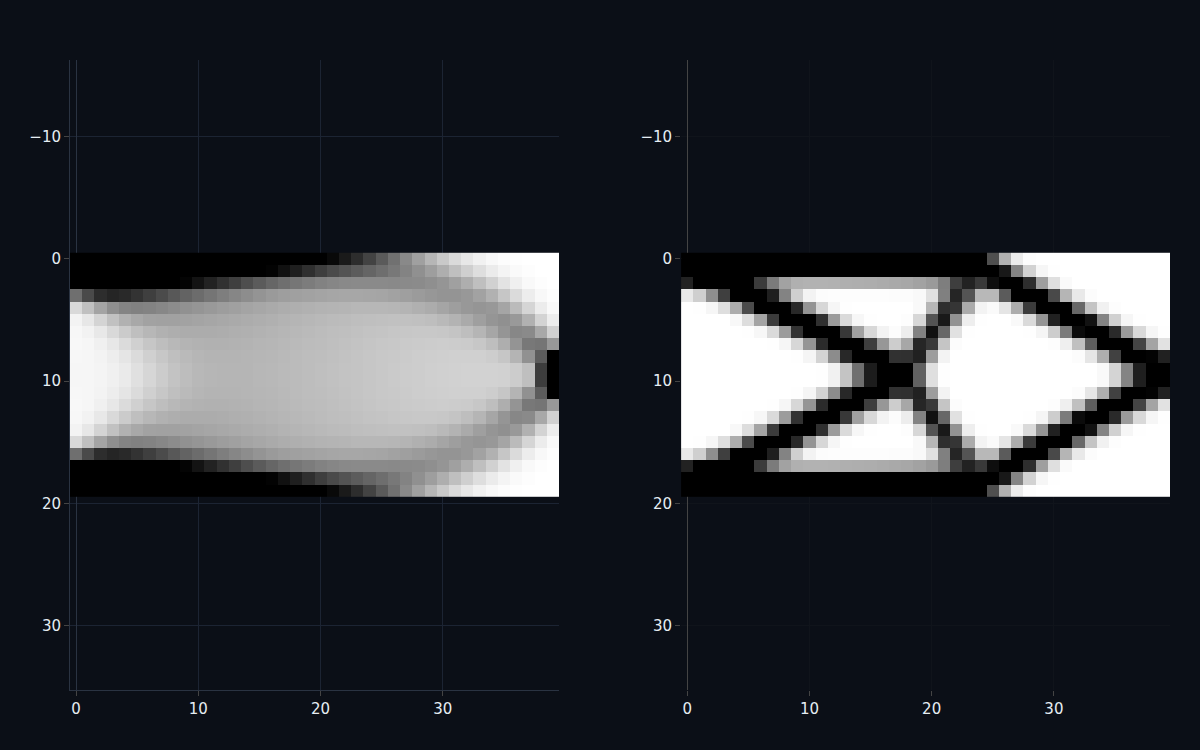
Reproduce the result everyone in the field knows.
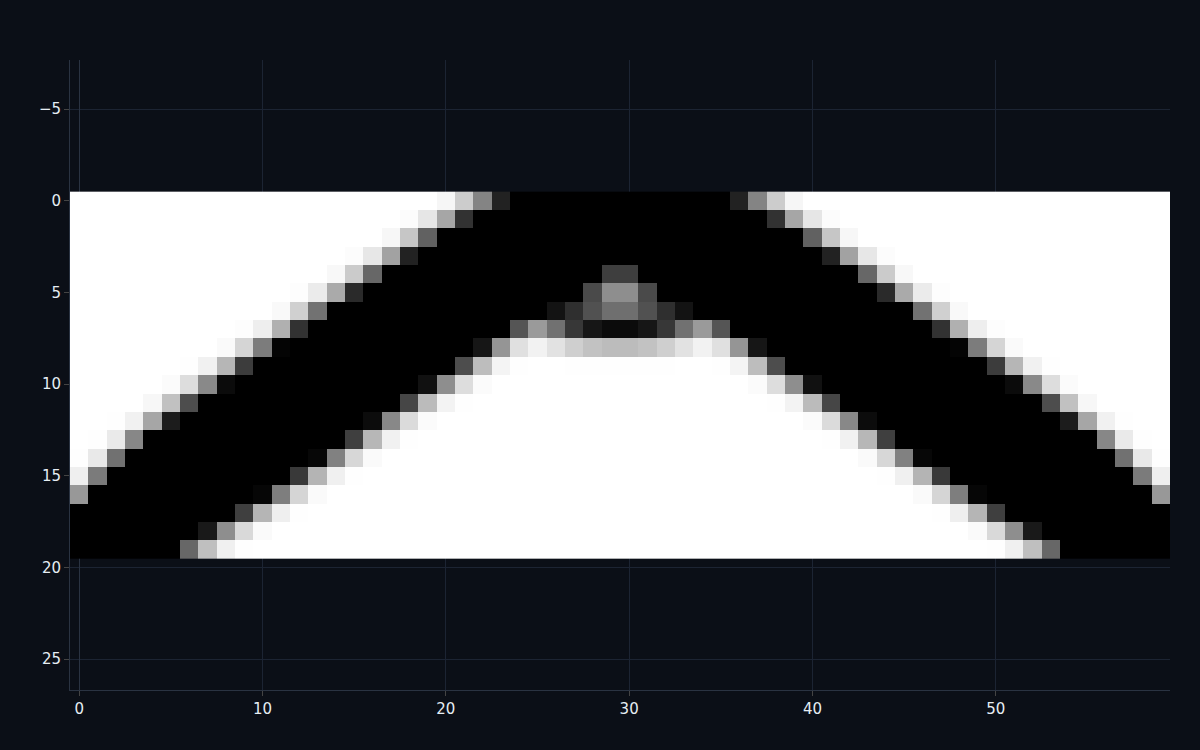
The MBB beam — a simply-supported span under a central load — is the canonical topology-optimization benchmark, in every textbook and every solver's test suite. The optimizer recovers its iconic arched, trussed form, validating the whole pipeline against the result the field agrees on. Get the benchmark right and the rest of the program's structures can be trusted.
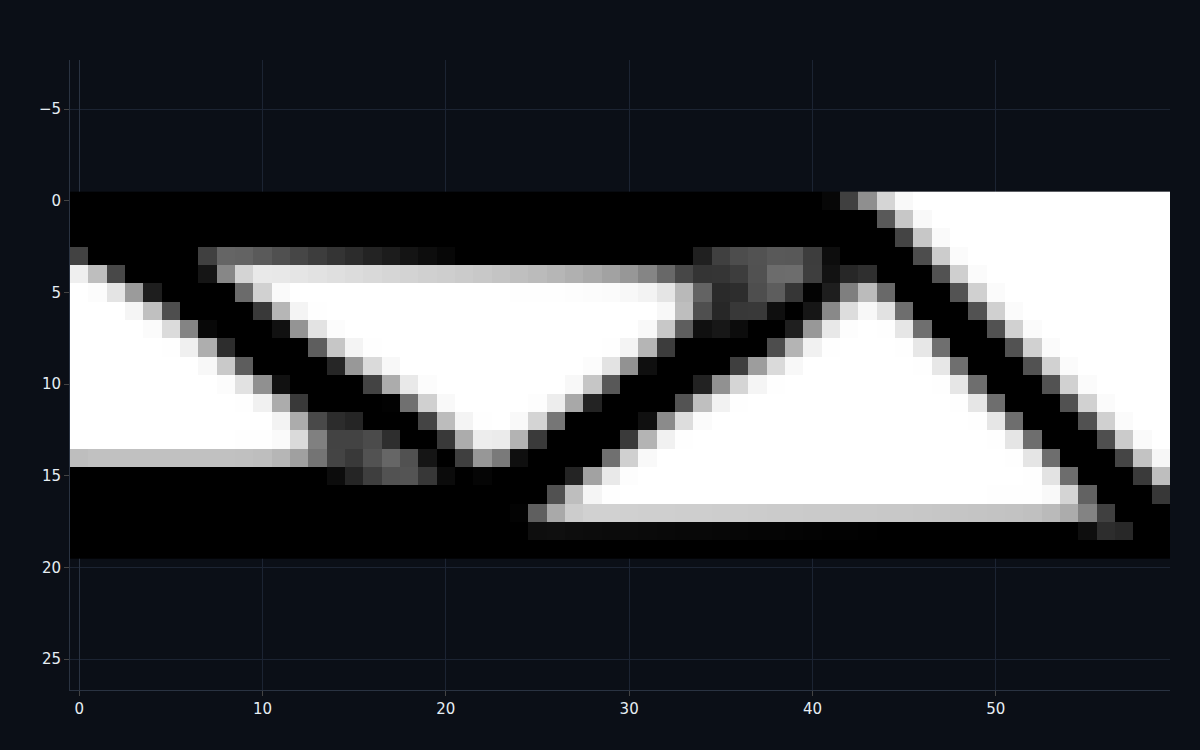
Two fixes that separate a toy from a tool.
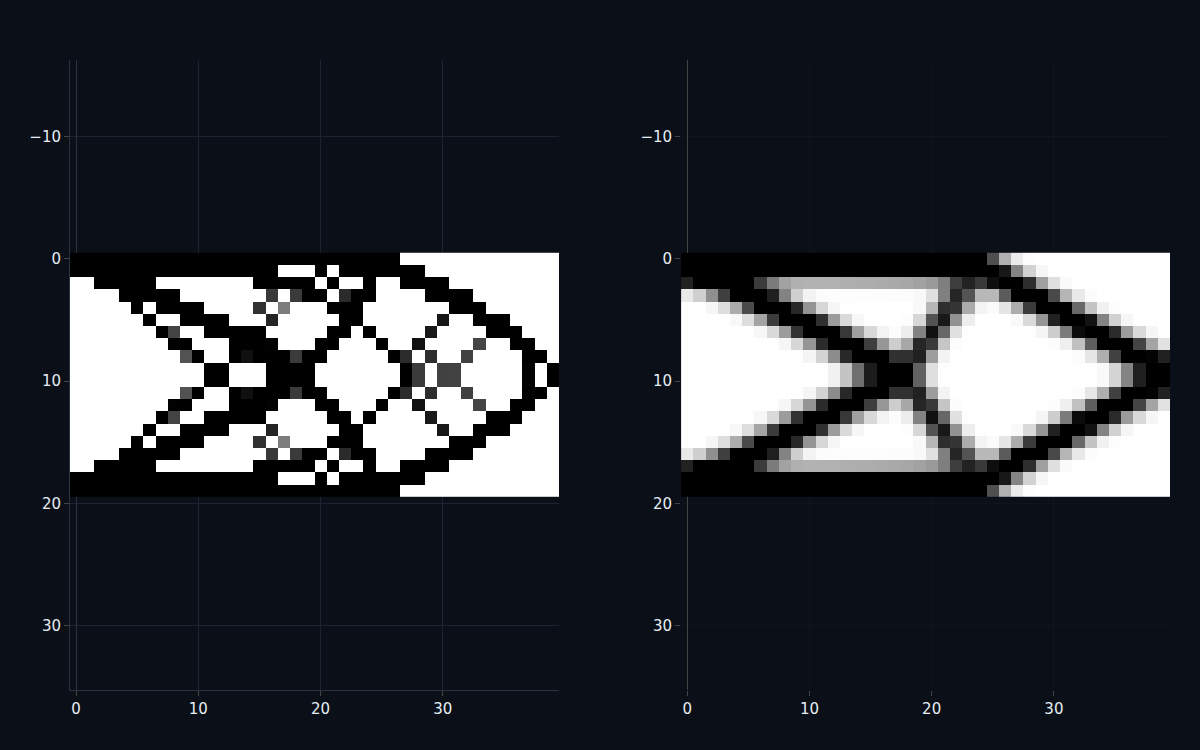
A naive optimizer produces a checkerboard of alternating solid and void cells — a numerical artifact that's stiff on paper and impossible to build. A sensitivity filter, blurring the design over a small radius, removes it and makes the result mesh-independent (refine the grid, get the same structure, not a finer pattern). It's the unglamorous detail that turns the method from a curiosity into something an engineer can actually use.
Change the problem, get a different structure.
Topology optimization isn't a library of shapes — it responds to whatever you ask. Change the supports and load from a cantilever to a pinned-end span with a load on top, and instead of a bracket the optimizer grows an arch with a tie, a bridge. Change the material budget and the topology reorganizes; give it several load cases and it finds a structure that handles all of them. The shape always follows the problem.
Every number re-derived at sign-off.
The V&V notebook rebuilds the optimizer from scratch and re-derives each requirement, printing a PASS/FAIL board.
| Result | Requirement | |
|---|---|---|
| Compliance reduction (cantilever) | 7.0× (615→87.6) | R-01 ≤ 5× |
| Volume-budget error | 6e-6 | R-02 < 1e-3 |
| Design discreteness | 0.20 | R-03 < 0.25 |
| Checkerboard (filter on) | 0.06 → 0.00 | R-04 |
| Volume–compliance trade-off | monotone | R-05 |
A real optimizer, at teaching fidelity.
The deliverable is ten notebooks and the dossier — FEM-in-the-loop on a density field, not an acausal network, so there's no custom block or canvas. It's 2D plane-stress minimum-compliance only, with SIMP plus a sensitivity filter and an optimality-criteria update (not the MMA or level-set methods of a production solver), at modest mesh resolution, single-material, with no stress, buckling or manufacturing constraints — and the gray-scale result needs a final threshold to become a clean manufacturable boundary. What the program proves is the capability the portfolio lacked: design optimization, where the optimizer discovers the shape — reusing the finite-element solver from the FEA flagship, validated against the MBB benchmark, every number re-runnable.
Let the optimizer design your part.
Book a walkthrough and we'll set up your loads, supports and material budget, and run the topology optimization to discover your structure live.