
The model becomes the firmware. In Rust.
Simulating a system is half the job; shipping it is the other half. DjiniousLab code-generates a controller you designed as a block diagram into a self-contained, memory-safe Rust crate — proven equivalent to the model, cross-compiled to a microcontroller, and cryptographically attested. This is what Simulink's Embedded Coder does, except the generated artifact is Rust, not C — the difference that matters when the code is going somewhere safety-critical.
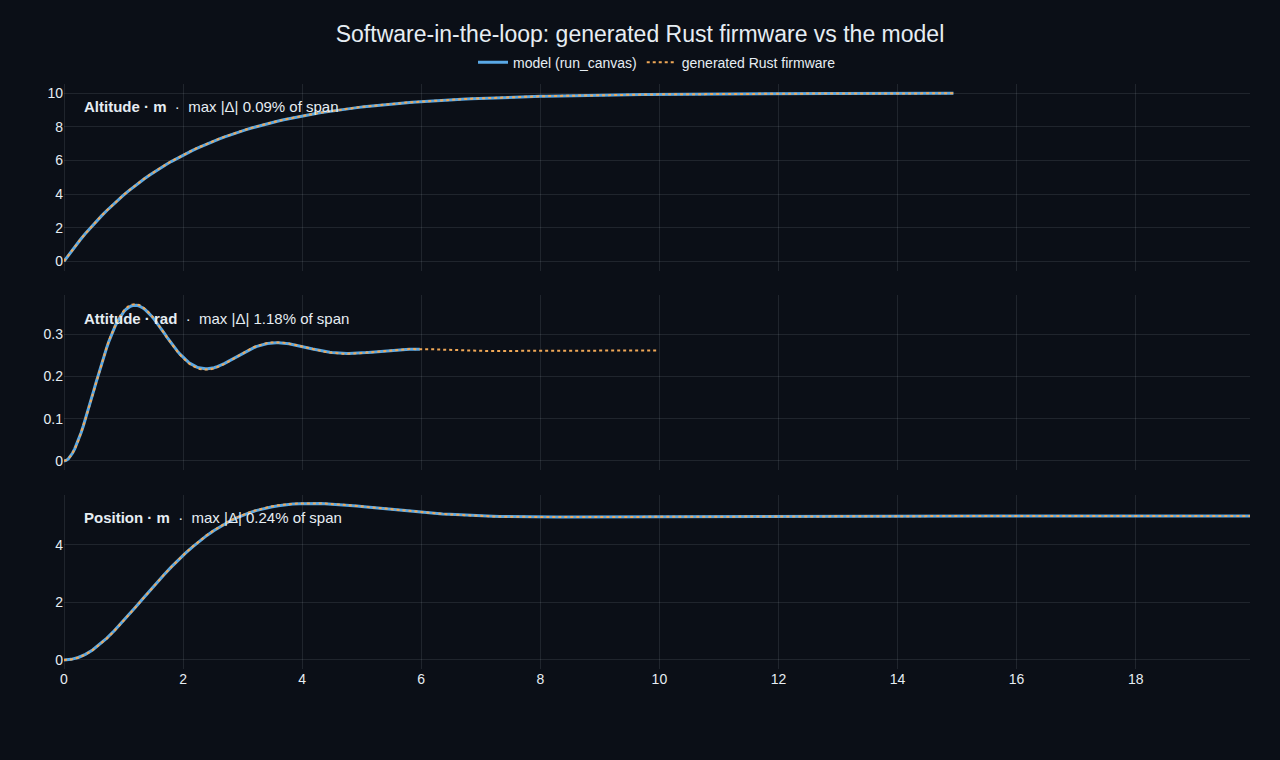
One command from block diagram to crate.
A control loop authored as a .djl block diagram lowers to a flat intermediate representation, and `djinious codegen` turns it into a Cargo crate: a State struct, an initial-condition constructor, and a `pub fn step(state, inputs, t, dt) -> Outputs` that advances the controller one tick. Add `--no-std` and it emits embeddable firmware with libm for math instead of the standard library. The same three Djinborn T4 autopilot loops — altitude, attitude, position — that the quadcopter program flies in simulation generate straight to Rust.
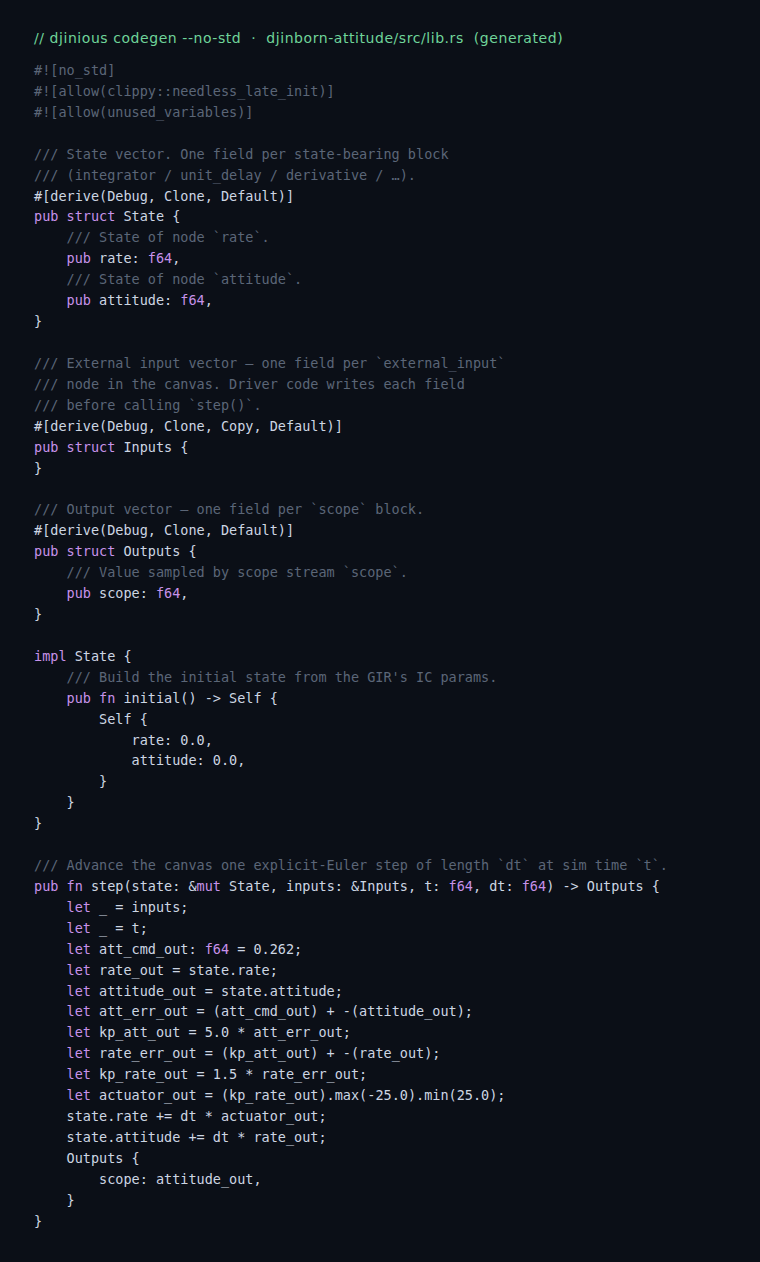
Closed loops, not just feedforward chains.
A controller is a feedback loop — the integrator output loops back into the error. The codegen used to emit blocks in declaration order, so a fed-back integrator's output could be referenced before it was bound: Rust that doesn't compile. The fix emits output bindings in topological order, treating integrator and delay outputs as dependency-free sources (their output reads stored state), which breaks the cycle; state updates are deferred to the end of the step. A feedback loop with no state element to break it is a genuine algebraic loop and now errors honestly instead of generating broken code. The full codegen suite — 765 unit tests plus 523 compile-and-run round trips — stays green.
The generated code is the differentiator.
Memory-safe by construction
No buffer overruns, no use-after-free, no undefined behaviour — the classes of bug that safety standards spend their pages trying to exclude from generated C are absent from Rust by the language's own guarantees.
Embeddable, no_std
The crates are `#![no_std]` with libm for transcendental math — no allocator, no operating system. They cross-compile to a bare-metal Cortex-M4F (STM32F4) target as verified here, ready for a board HAL and a timer ISR.
Provenance-attested
`djinious attest` binds the model to the firmware's SHA-256 in an in-toto Statement; `djinious sign` cosign-signs it. The supply-chain link from 'this model' to 'this binary' that certification asks for.
Proven equivalent
A software-in-the-loop harness runs the model and the firmware side by side and differences them — the generated code is gated on matching the reference, not assumed to.
Every claim is a command you can re-run.
The whole pipeline is real artifacts — lower, codegen, compile, run, diff, cross-compile, attest — not a slideware demo.
| Step | Result | |
|---|---|---|
| Loops code-generated & compiled | 3 / 3 | altitude · attitude · position |
| SIL deviation (firmware vs model) | < 1.2% | of span, all three |
| Embedded cross-compile | thumbv7em | Cortex-M4F rlib |
| Provenance | in-toto v1 | model → firmware digest |
| Codegen test suite | green | 765 + 523 round-trips |
Embedded-grade, signal-flow codegen.
The generated code is fixed-step forward-Euler — the embedded norm — over the catalog signal-block palette (constant, sum, gain, integrator, saturation, scope and friends), which is exactly what a controller is built from. Custom nonlinear DJL components don't code-generate yet; they run in the Julia worker. Flashing onto a specific board needs a HAL crate and a `cortex-m-rt` entry point, and `sign` / `verify` need a local cosign — board integration and CI signing are beyond this program. What it delivers is the spine of model-based design done in Rust: design, simulate, generate, prove equivalent, and trace — end to end, on one tool.
Generate your controller to Rust.
Book a walkthrough and we'll take a control loop you care about from block diagram to a compiling, SIL-verified, attested Rust crate — live.