
An EV battery pack, modelled where the disciplines meet.
Cell electrochemistry, pack thermals, and the battery-management system don't live in separate tools here. A 96S2P NMC pack is built as one composition — equivalent-circuit cells coupled to a thermal network, wrapped in a closed-loop CC-CV charger and an active balancer — and solved together, electrical and thermal and control in a single elaboration.
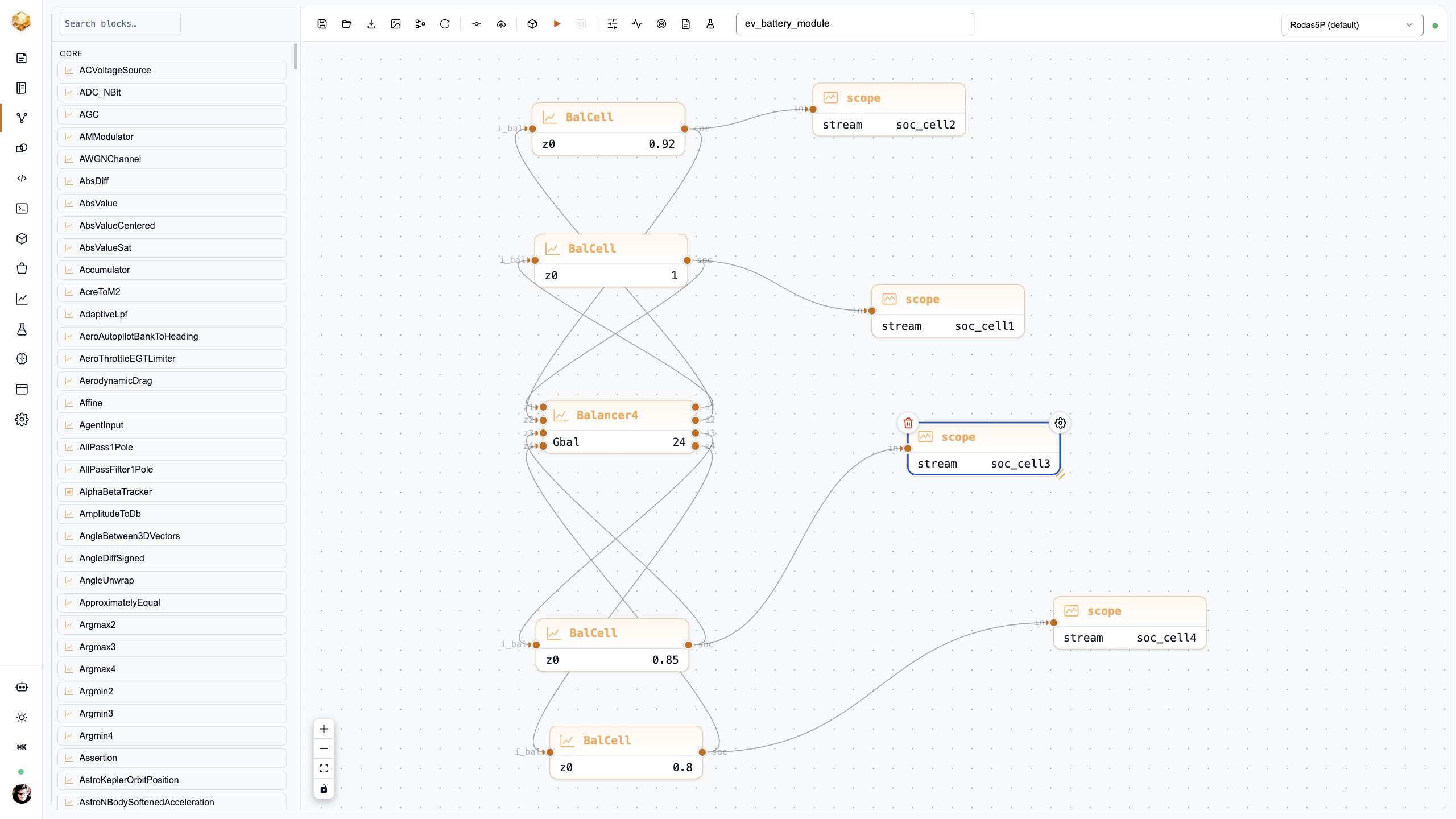
One pack, composed from one cell.
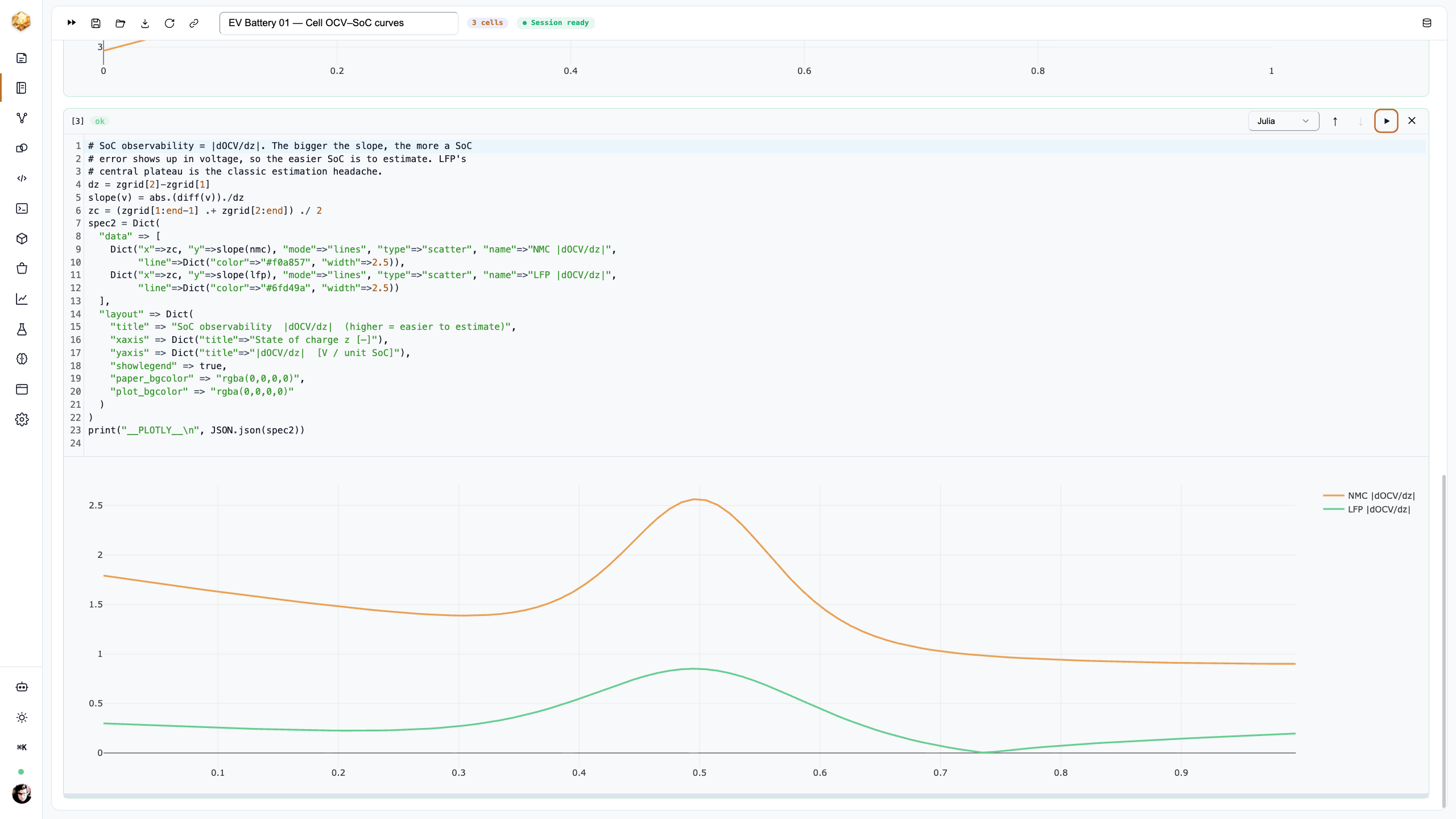
A single equivalent-circuit cell is the atom; the module and pack are compositions of it. Each layer is its own runnable model, and they share one cell definition.
Equivalent-circuit cell
A Thevenin 1-RC cell — series resistance, one RC polarization pair, a non-linear OCV(z) curve and coulomb-counted state of charge — written once and reused at every level.
Thermal node
Ohmic and polarization loss become heat that drives a lumped thermal mass with convective bleed to ambient. Temperature is a first-class state, not an afterthought.
BMS charge control
A saturated-proportional control law reads pack voltage and commands a charge current — reproducing the textbook constant-current → constant-voltage envelope without any mode-switching events.
Active balancer
A charge-shuttling balancer moves charge between imbalanced cells toward the module mean — conserving total charge while the spread collapses in minutes.
State estimation
An Extended Kalman Filter fuses noisy voltage and biased current to track SoC online, where a bare coulomb counter would drift.
Safety envelope
An over-temperature throttle with hysteresis derates the charge current to hold the hottest cell at its cap — the BMS protecting the pack, in the loop.
Electrical, thermal and control, solved together.
The acausal electrical network, the per-cell heat path, and the signal-domain control loop are elaborated into one differential-algebraic system that a stiff Rodas5P solver integrates as a whole — no co-simulation hand-off, no manual time-stepping between tools. A 1C discharge of the cell drops SoC from full to 16.7%, sags the terminal from 4.10 V to 3.21 V, and lifts the cell about 1.4 °C, all from the same coupled equations. The same model exports as an FMI 2.0 co-simulation unit for Simulink, dSPACE and other FMI hosts.
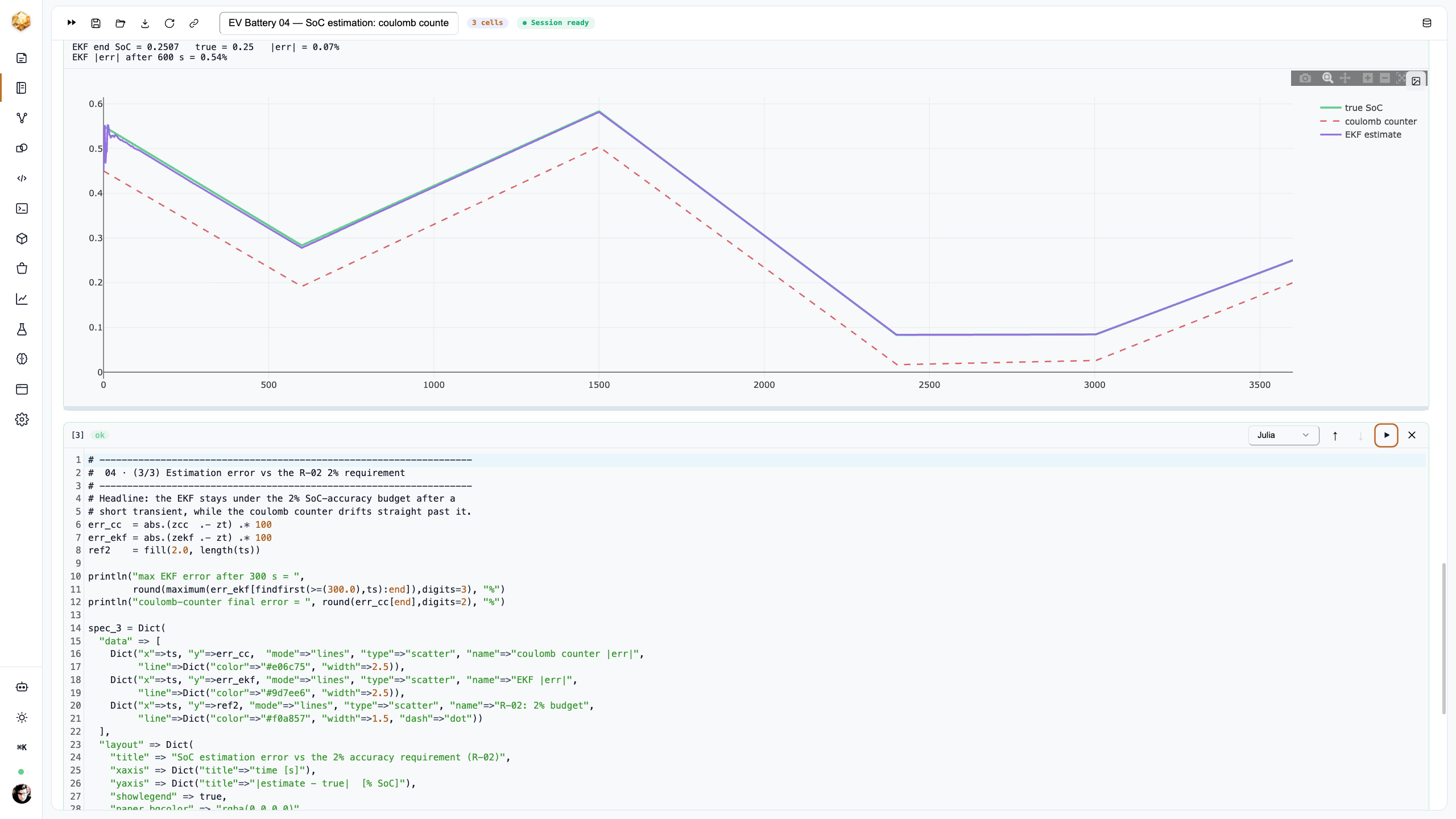
An EKF that holds where a counter drifts.
Run the pack over a mixed charge/discharge profile with a noisy voltmeter and a biased ammeter. A pure coulomb counter — the cheap baseline — walks off to about 5% SoC error. The Extended Kalman Filter on the cell's [SoC, polarization] state corrects from the voltage residual and ends within 0.07% of truth, holding under ~0.7% after the first few minutes — comfortably inside a 2% accuracy budget.
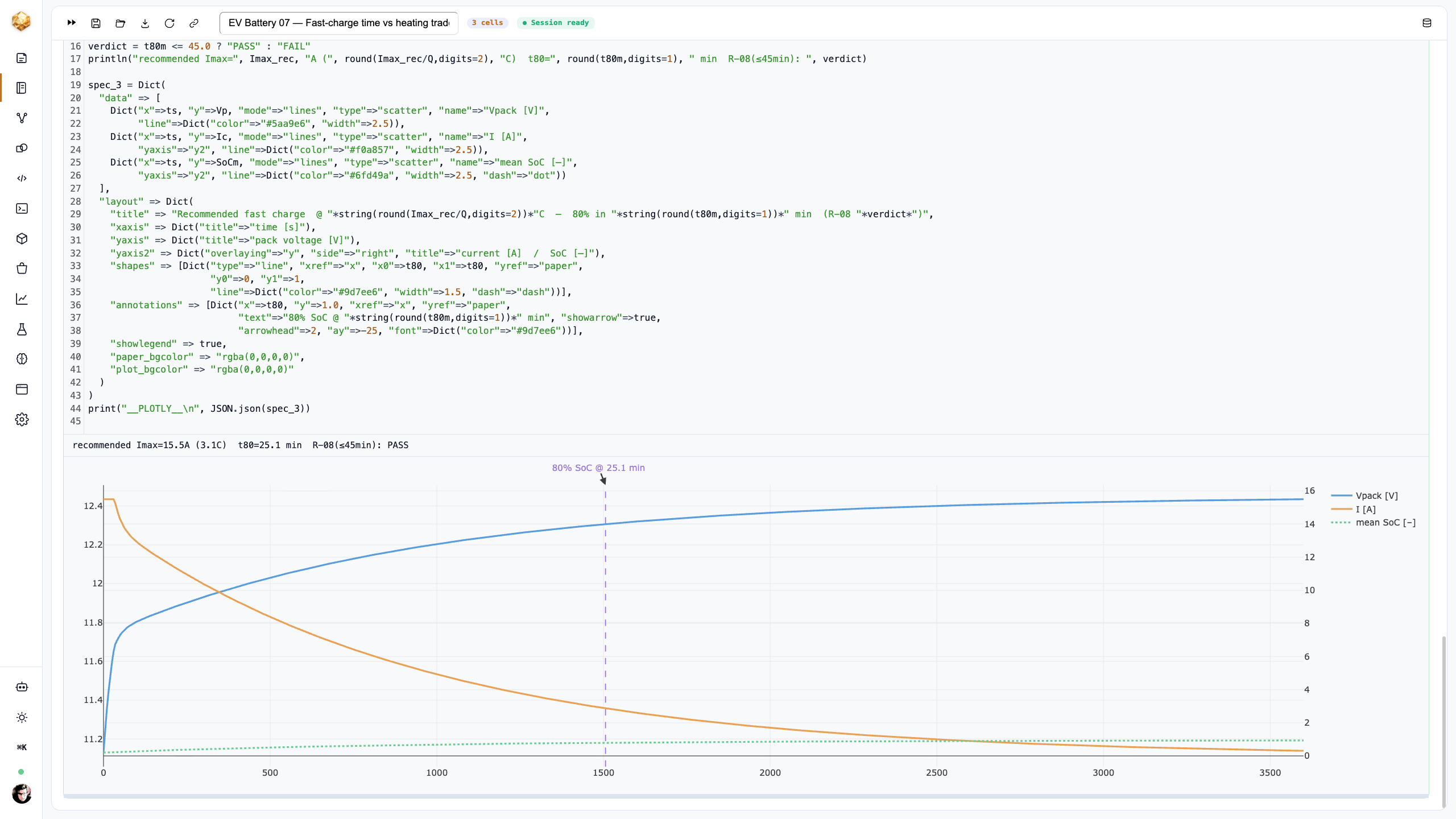
The CC-CV envelope, from a single control law.
The charge controller commands a current proportional to the gap between pack voltage and the CV set-point, clamped to a maximum. Far from the set-point it saturates — that's the constant-current phase; as the pack fills, the command falls out of saturation and tapers — that's constant-voltage. Sweeping the current limit against peak temperature finds the knee: about 3.1C reaches 80% state of charge in 25 minutes while staying inside the thermal limit.
The details that decide correctness.
Charge-positive sign
Terminal current is defined positive into the + pin, so positive current charges. A discharge load forces +I into its own pin and Kirchhoff's law makes the cell see −I — get that backwards and the pack silently charges instead of discharging.
Causal heat path
The canvas engine rejects a single component that bridges two acausal domains, so the cell can't carry both an electrical and an acausal thermal port. Heat is emitted as a signal and integrated by a thermal block instead — same physics, a model that actually compiles.
The BMS algebraic loop
The charge current appears in the measured pack voltage through the ohmic drop, closing an algebraic loop. The saturated proportional law keeps it well-posed, and the solver resolves it every step — confirmed against an analytic CC→CV cross-check.
Charge-conserving balancing
Each cell exchanges a current proportional to its distance from the module mean. The corrections sum to zero, so the average SoC is preserved exactly while the spread decays — active shuttling, not dissipative burn-off.
Every claim is a number you can re-run.
The notebooks and .djl studies are gated on verified live-worker results, with the physics cross-checked by independent integration of the same equations.
| Result | Target | |
|---|---|---|
| EKF SoC error | 0.07% | ≤ 2% |
| Active-balancing spread (20 min) | 0.3% | from 20% |
| Fast charge to 80% SoC | 25.1 min | ≤ 45 min |
| Cycle life to 80% @ 25 °C | 781 cycles | ≥ 500 |
| Drive-cycle regen recovered | 28% | — |
From text model to design twin.
The cell, module and pack are pure-text DJL. The parser lowers them to a flat intermediate representation, then to a ModelingToolkit symbolic system the Julia worker integrates — streaming live scopes back into the browser — and the catalog circuits export as functional FMI units. Eleven notebooks carry the engineering narrative end to end: OCV characterization, equivalent-circuit identification, thermal C-rate response, SoC estimation, balancing, BMS control, fast-charge trade-offs, cycle and calendar aging, and a full drive cycle — a design-iteration twin you exercise long before a cell is ever assembled.
Design-grade, equivalent-circuit fidelity.
The cell is an equivalent-circuit surrogate, not an electrochemical (Newman P2D / single-particle) model — it captures voltage, state of charge and lumped heat, not concentration gradients, plating or detailed degradation chemistry. OCV is a smooth analytic curve in the .djl atom and the realistic NMC/LFP shapes live in the notebooks; aging is empirical (Arrhenius throughput and calendar laws). What it is good for is exactly what pack and BMS design needs first: sizing series/parallel counts, choosing the thermal budget, tuning the charge and balancing strategy, and trading fast-charge speed against heat — on your own cell numbers, in minutes, before any hardware exists.
Model your own pack, end to end.
Book a walkthrough and we'll drop in your cell, pack topology and thermal numbers and run the charge, balancing and drive-cycle studies live.