
Not every system is a differential equation.
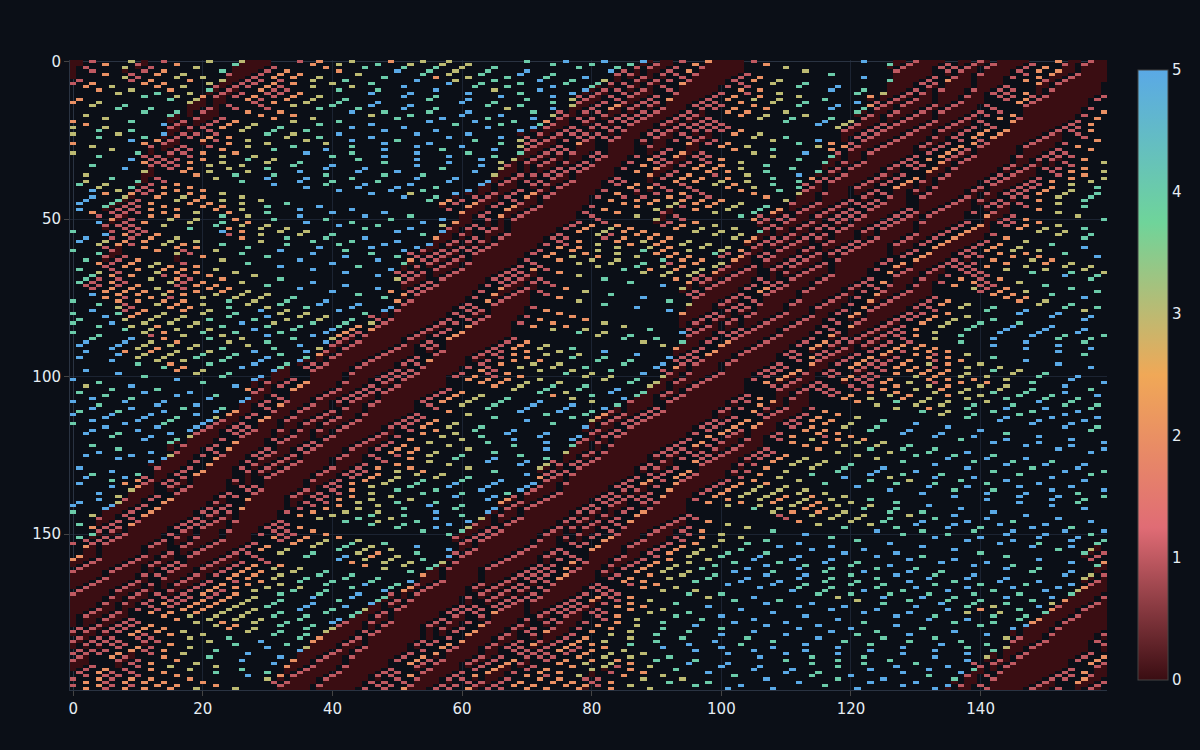
A queue, a factory line, a road full of cars, an epidemic — these don't evolve as smooth fields. They jump: a customer arrives, a machine finishes, a car brakes, someone gets infected. This is discrete-event and agent-based simulation, the paradigm behind SimEvents, Arena and AnyLogic — and a whole class of modelling the rest of the portfolio, all differential equations, never touches. This program builds it both ways: queues grounded in closed-form theory, and emergent behavior that arises from nothing but local rules.
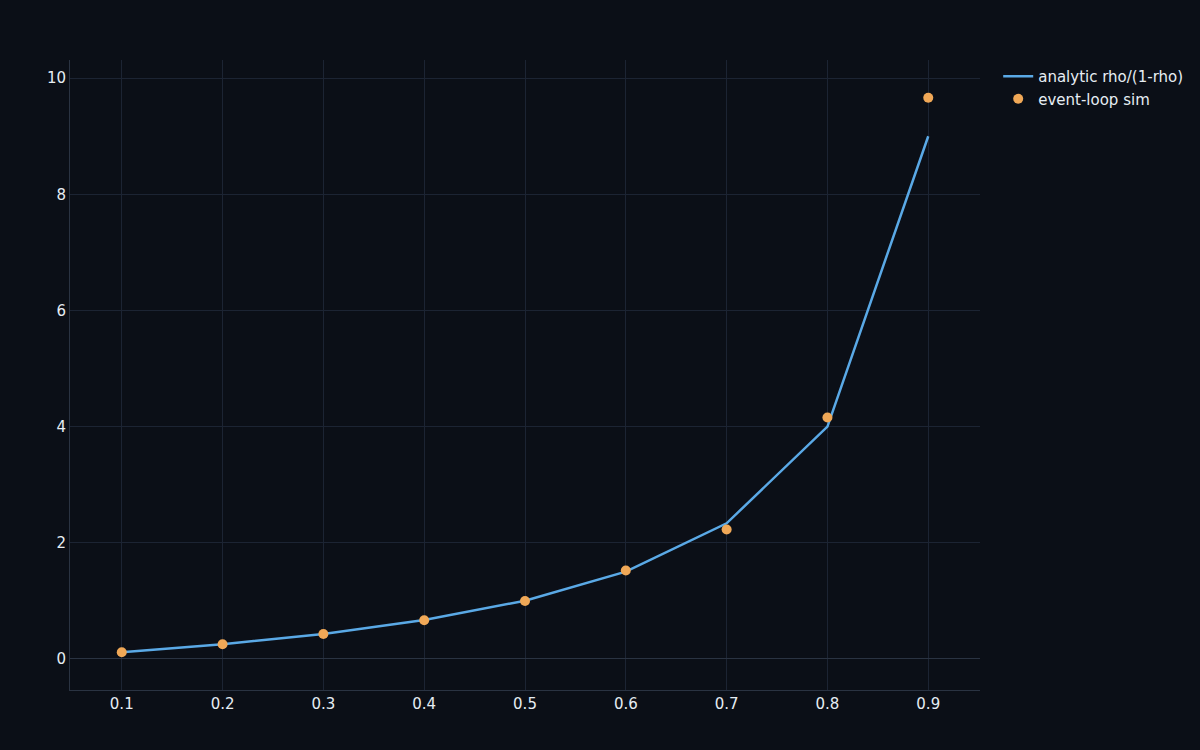
First, match a result you can prove on paper.
The M/M/1 queue — random arrivals, one server, random service — has an exact closed-form answer from queueing theory. The program builds it as a hand-rolled event loop (advance to the next event, update, repeat) and lands the mean queue length within 2.5% of the analytic L = ρ/(1−ρ), recovering the geometric stationary distribution along the way. Little's law (L = λ·W) holds to a zero residual across every load. That agreement with theory is what licenses everything the simulation does where no formula exists.
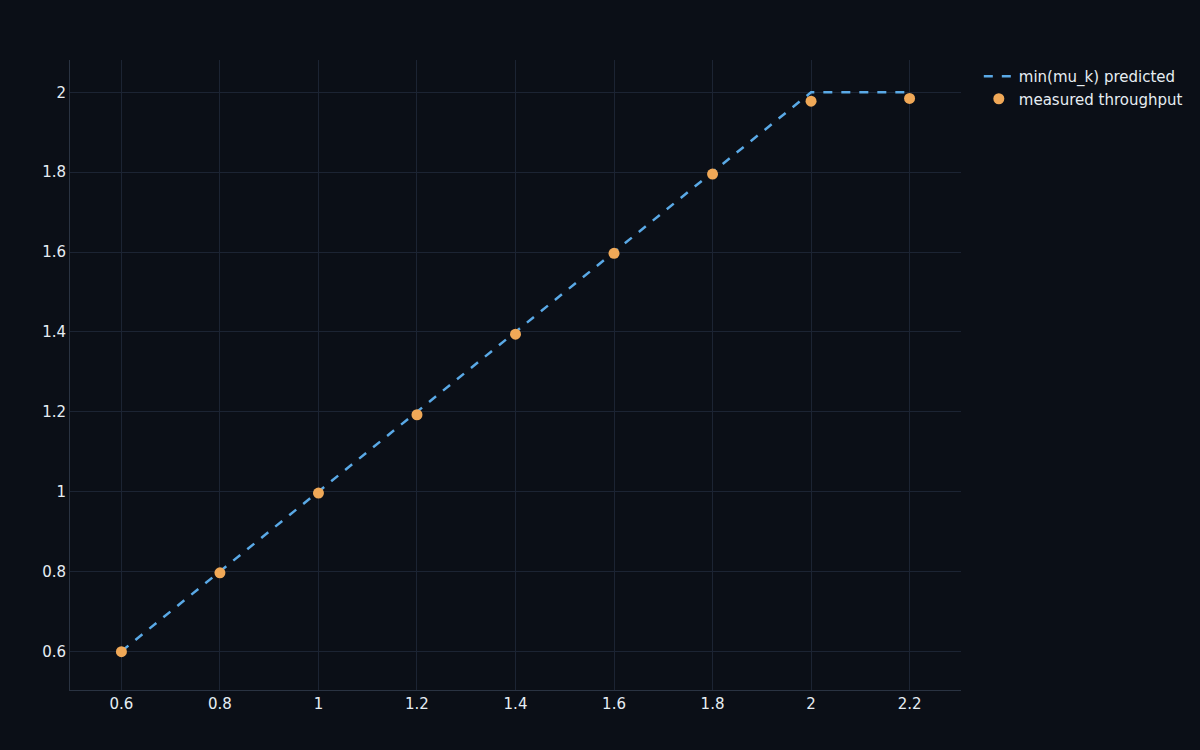
A line runs as fast as its slowest station — and no faster.
Put workstations in series with buffers between them and the line's throughput is gated entirely by the bottleneck station; adding capacity anywhere else does nothing, and work-in-process piles up just upstream of the constraint. The simulation reproduces the Theory-of-Constraints result exactly — throughput tracks the bottleneck rate to within 0.4% — and shows where the inventory accumulates. This is the everyday logic of factory and logistics design.
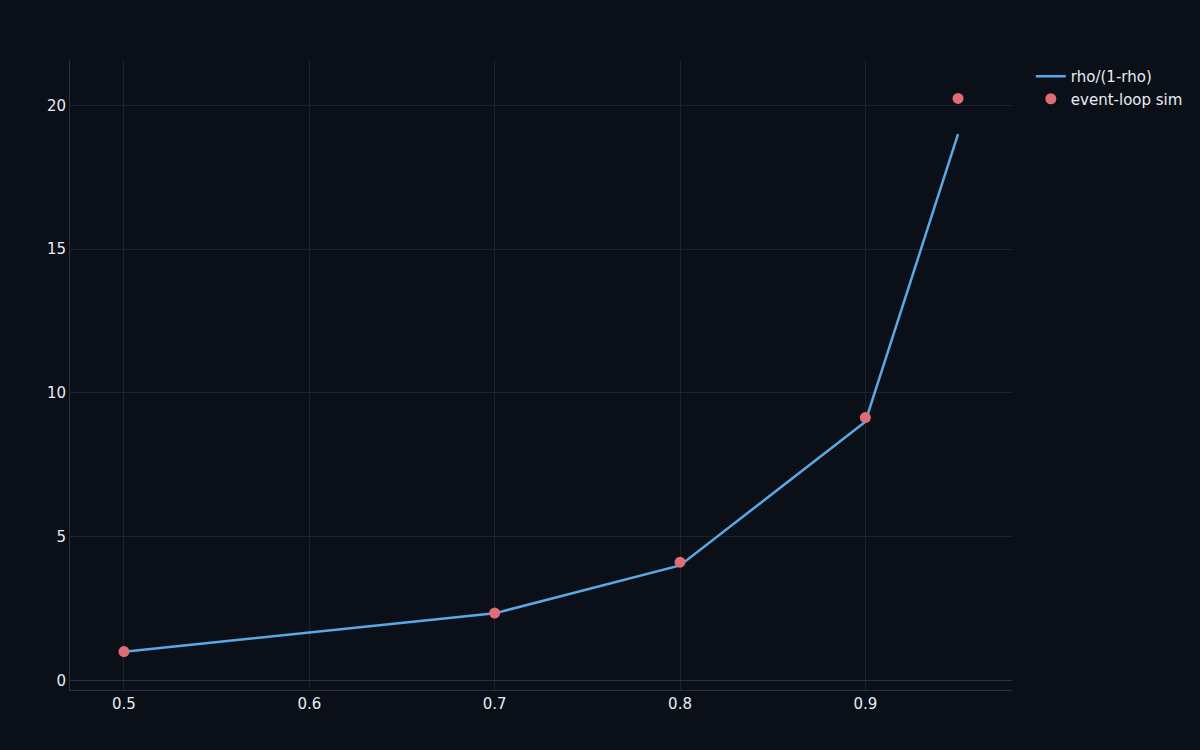
Run a system near full utilization and the wait explodes.
It's tempting to load a server to 95% for efficiency. Kingman's formula — and the simulation — show why that's a trap: waiting time grows without bound as utilization approaches 1, and it grows with variability even at fixed average load. A system that's busy 95% of the time isn't 5% slower than one at 90%; it can be several times slower. Variability, not just average load, is what drives queues — the lesson behind every capacity-planning decision.
The same idea models an epidemic.
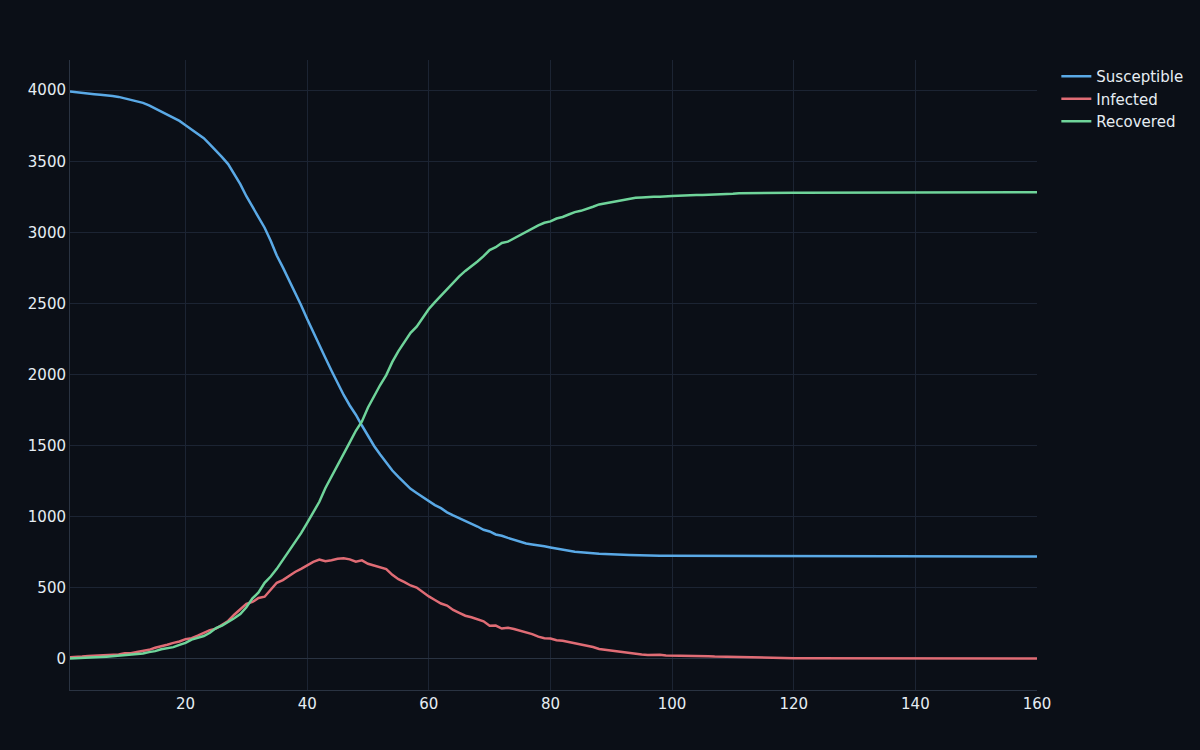
Swap cars for people and braking for infection and the agent-based paradigm models an outbreak: each individual contacts others at random, infection spreads, the infected recover. No differential equation is imposed — the familiar susceptible/infected/recovered curves emerge from the population of agents, and sweeping the contact rate recovers the R₀ = 1 epidemic threshold where outbreaks take off. From traffic to contagion, the same simulation paradigm.
Every number re-derived at sign-off.
The V&V notebook rebuilds each model from scratch and re-derives the requirements against theory, printing a PASS/FAIL board.
| Result | Requirement | |
|---|---|---|
| M/M/1 sim vs analytic L | 2.5% | R-01 < 5% |
| Little's-law residual | 0.0 | R-02 < 0.05 |
| Tandem throughput vs bottleneck | 0.4% | R-03 < 0.1 |
| Traffic jam emergence (variance) | 11.4 | R-04 > 1 |
| Fundamental-diagram capacity peak | 1.96× | R-05 > 1.1 |
A different paradigm, validated where it can be.
The deliverable is ten notebooks and the dossier — event loops and cellular automata, not an acausal network, so there's no custom block or canvas. The queueing notebooks assume Markovian (exponential) arrivals and service so they can be checked against closed-form theory; the cellular-automaton and agent rules are idealized; results are single long runs rather than ensembles with confidence intervals, and there's no rare-event or steady-state-detection machinery. What the program proves is the paradigm itself — that the platform models discrete-event and agent-based systems, not just differential equations — anchored to queueing theory where exact answers exist and showing genuine emergence where they don't.
Model your own queue, line, or population.
Book a walkthrough and we'll set up your event-driven or agent-based model — a service system, a production line, a network — and run the throughput and bottleneck studies live.