
One tank, three steady states, and a runaway.
Put an exothermic reaction in a cooled stirred tank and the simplest reactor in chemistry turns into a nonlinear-dynamics showcase. The heat it makes rises steeply with temperature while the heat you remove rises only linearly — and where those curves cross can give one operating point or three, sudden ignition and extinction, self-sustained oscillations, or a thermal runaway. This program maps all of it from the coupled mass and energy balances, then shows how feedback control holds the reactor where it otherwise can't sit.
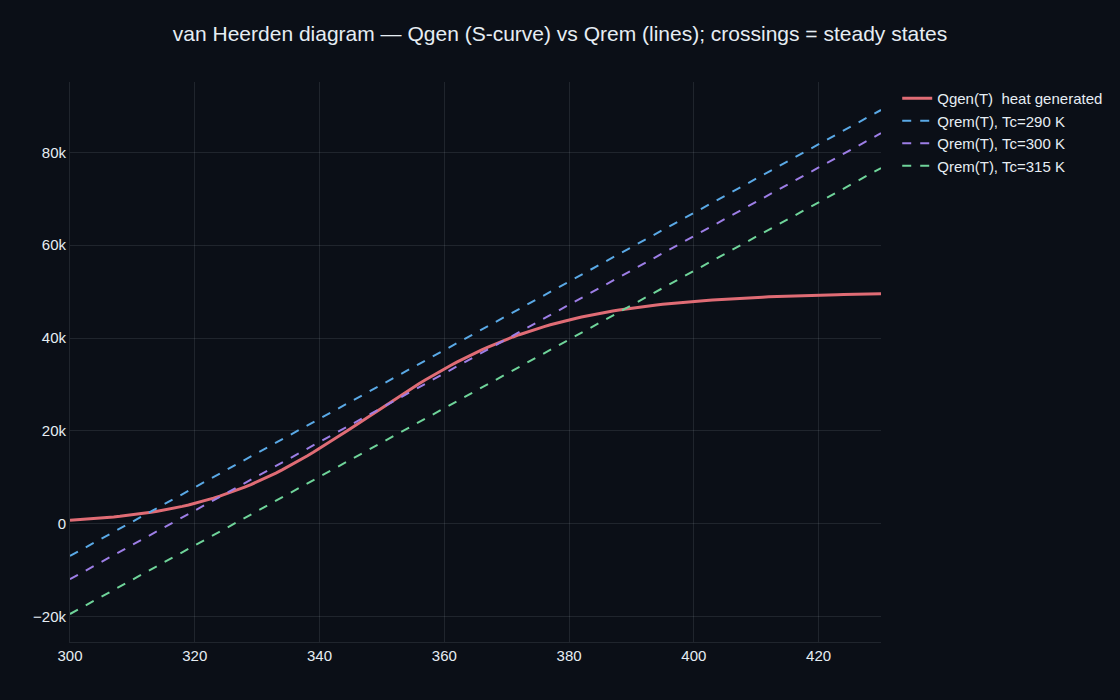
Heat made vs heat removed.
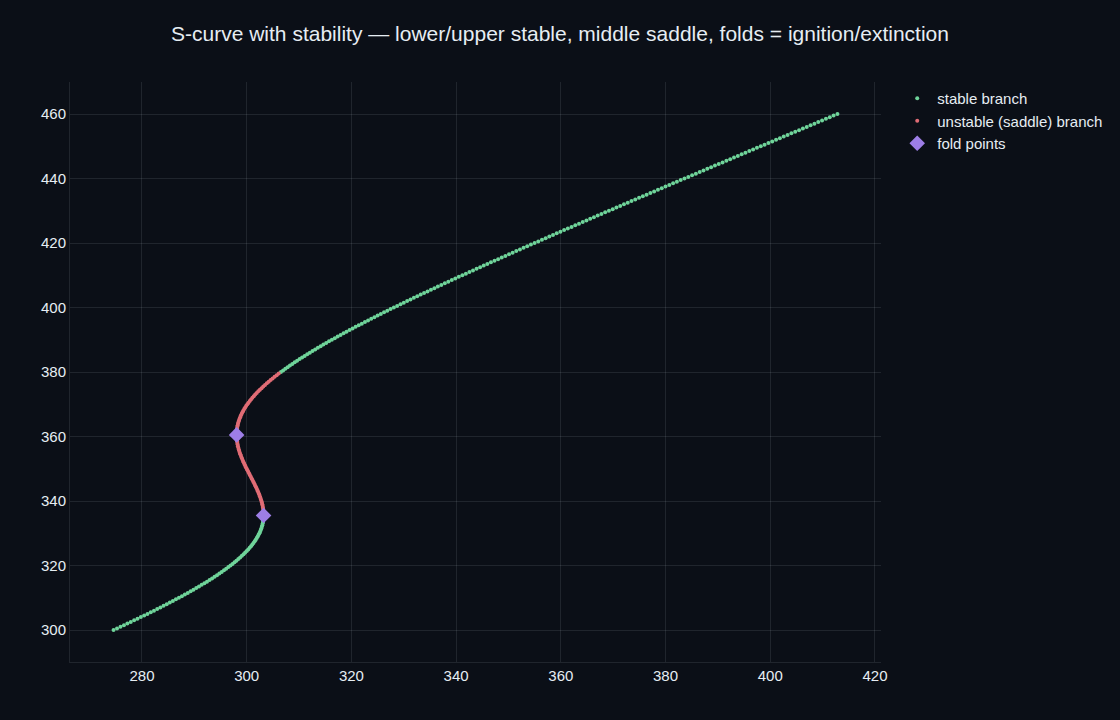
The reaction rate climbs exponentially with temperature, so the heat it generates is an S-shaped curve; the cooling jacket removes heat along a straight line. Where the S crosses the line is a steady state — and an S can cross a line in three places. The middle crossing is unstable, the outer two are stable, and as you slide the coolant temperature the stable states appear and vanish at fold points. That's the van Heerden picture, and it's why the same reactor can sit cold and barely reacting or hot and nearly complete, depending only on its history.
It can oscillate, and it can run away.
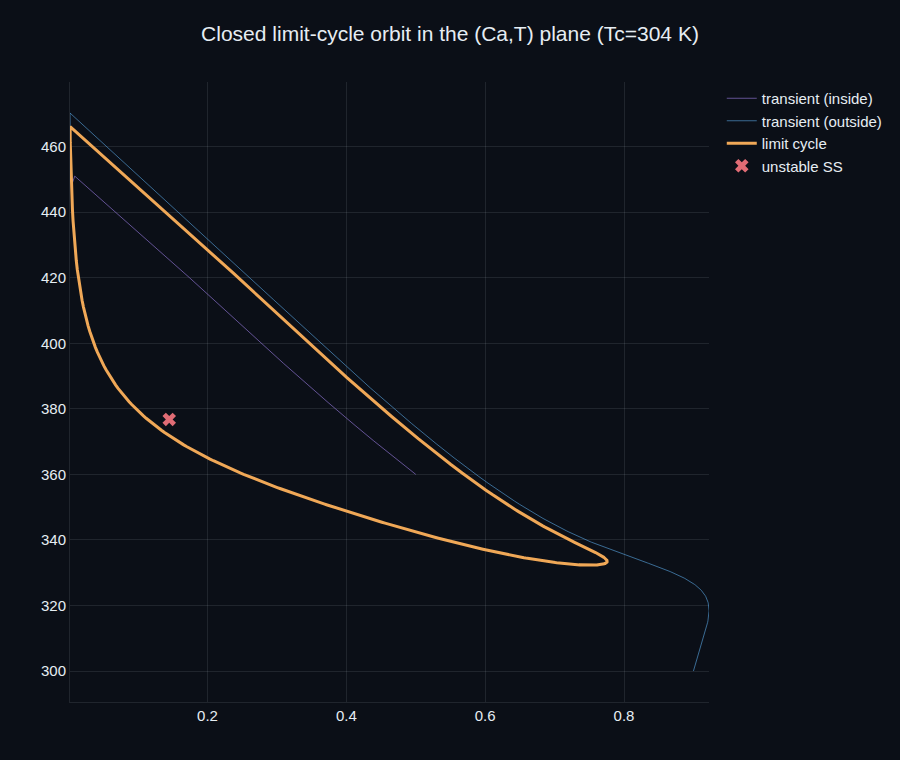
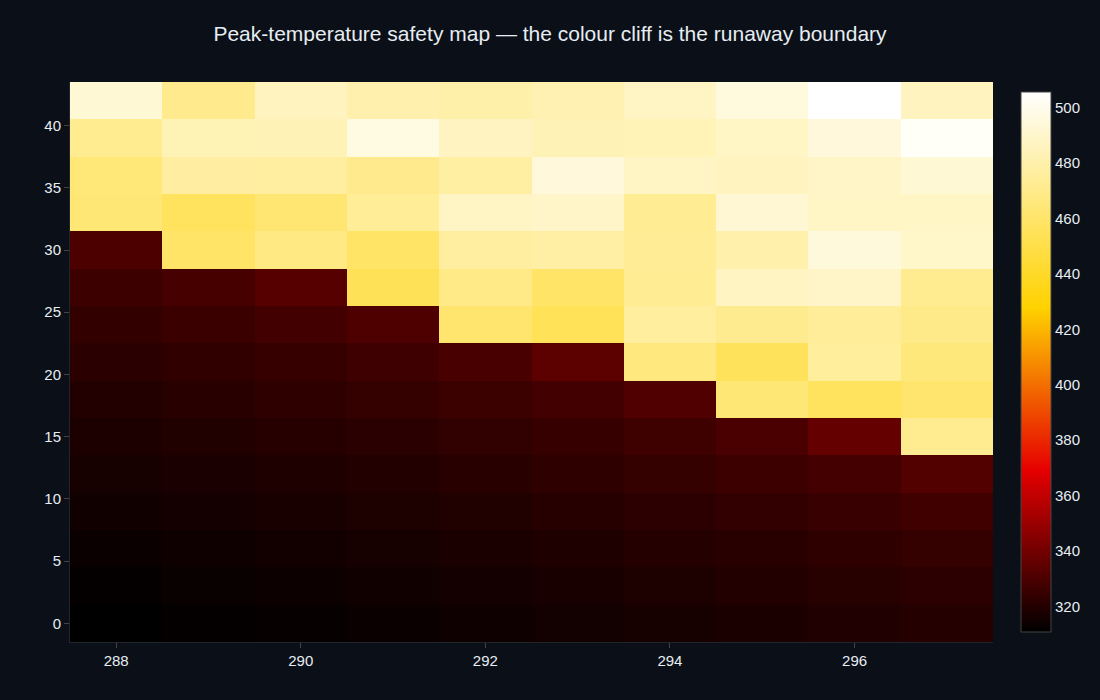
Multiplicity isn't the only surprise. Around the unstable middle state the reactor can settle into a self-sustained limit cycle — temperature swinging more than a hundred degrees, forever, with no changing input — a Hopf bifurcation. And push the feed too hard and the heat generation outruns the cooling entirely: a +10 K disturbance is absorbed, but a +20 K one ignites a thermal runaway to over 460 K. The program draws the limit-cycle orbit in the phase plane and maps the runaway boundary — the safety envelope a real reactor has to stay inside.
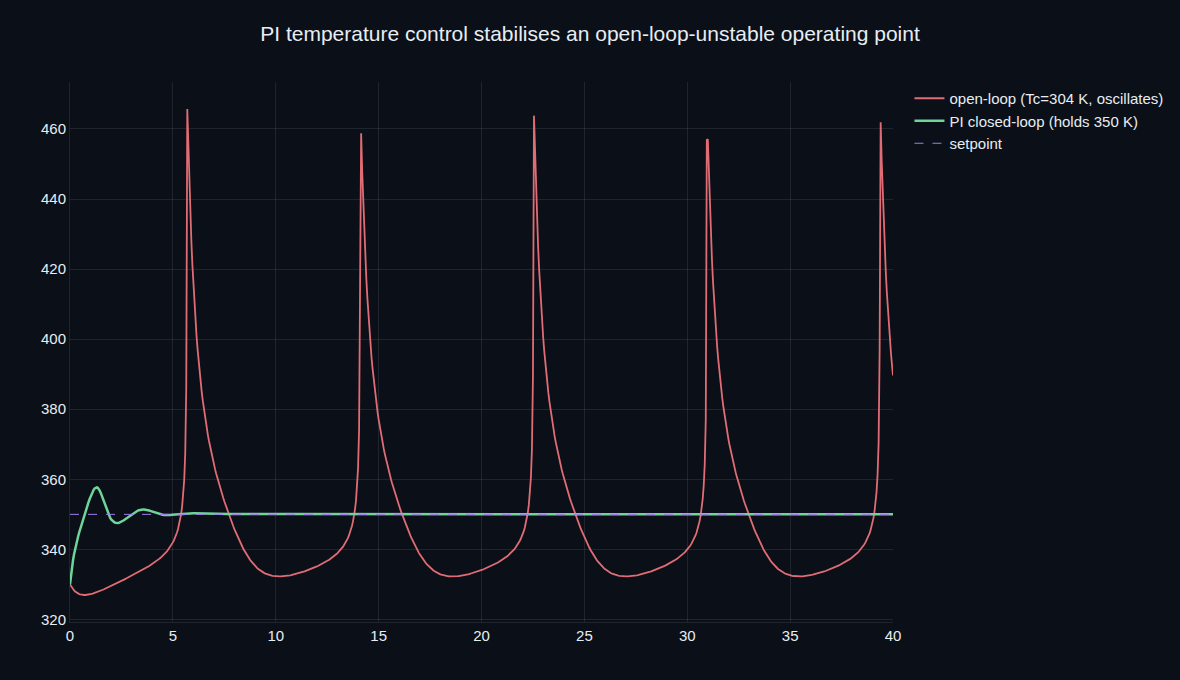
Every number is one you can re-run.
The sign-off notebook re-derives each requirement from the same coupled balances the program builds.
| Result | Requirement | |
|---|---|---|
| Steady states (Tc = 301 K) | 3 | multiplicity |
| Ignition/extinction hysteresis | 5.1 K | 303.2 / 298.1 K |
| Limit-cycle amplitude | ~134 K | sustained (Hopf) |
| Runaway threshold | +20 K kick | +10 K absorbed |
| Requirements verified | 7 / 7 | PASS |
One reaction, the whole zoo.
The reactor runs a single first-order exothermic reaction A→B in a perfectly-mixed lumped tank with constant physical properties — the Seborg-canonical model, not a detailed thermochemistry or a multi-reaction network. That minimal model is deliberately what shows the full nonlinear-dynamics zoo cleanly: multiplicity, hysteresis, the Hopf limit cycle, runaway, and feedback stabilization, all traceable by hand. It is exactly the fidelity reactor design and safety intuition need first — finding the operating points, mapping the runaway envelope, and designing the control — before a detailed kinetics or CFD model.
Model your own reactor.
Book a walkthrough and we'll set up your kinetics, heat of reaction and cooling, and run the multiplicity, runaway and control studies live.